
So, what is the Dog’s scariest nightmare, which also effects us humans more then us it effects dogs.
The living things which effects both of the living beings are Ticks & Fleas, ticks can dig inside humans & dogs skin, then into the blood cells & start feeding , while Fleas go inside humans & dogs grow into earthworms start mating which makes more worms then they go for the brain 🧠🔫 then the host dies while Fleas outside party 🍺 wow👏👏 they keep doing the same things again & again just like cycle.
How to Eradicate fleas
Generally speaking, an adult flea only lives for 2 or 3 months. Without a host to provide a blood meal, a flea’s life can be as short as a few days. Under ideal conditions of
temperature, food supply, and humidity, adult fleas can live for up to a year and a half.
How to get rid of fleas in your home
1.powerful vacuum on any floors, upholstery, and mattresses. …
2. steam cleaner for carpets and upholstery, including pet beds
3.Wash all bedding, including
your pet’s, in hot water. …
4.chemical treatments
Where do fleas lay eggs in the house ?
Carpeting, rugs, floorboard cracks, pet bedding, cushions and upholstery, beneath beds and furniture, and dirt floor basements.
Flea allergy dermatitis
Flea allergy dermatitis (FAD) is an eczematous itchy skin disease of dogs and cats. For both of these domestic species, flea allergy dermatitis is the most common cause of skin disease.
Genetic evidence indicates that fleas are a specialised lineage of parasitic scorpionflies sensu lato, most closely related to Nannochoristidae. The earliest known fleas are known from the Middle Jurassic, though modern looking forms do not appear until the Cenozoic. Fleas likely originated on mammals before later parasitising birds. Each species of flea is more or less a specialist with respect to its host animal species: many species never breed on any other host, though some are less selective. Some families of fleas are exclusive to a single host group; for example, the Malacopsyllidae are found only on armadillos, the Ischnopsyllidae only on bats, and the Chimaeropsyllidae only on elephant shrews.
The oriental rat flea, Xenopsylla cheopis, is a vector of Yersinia pestis, the bacterium which causes bubonic plague. The disease was spread to humans by rodents such as the black rat, which were bitten by infected fleas. Major outbreaks included the Plague of Justinian, c. 540 and the Black Death, c. 1350, both of which killed a sizeable fraction of the world’s population.
Fleas feed on a wide variety of warm-blooded vertebrates including humans, dogs, cats, rabbits, squirrels, ferrets, rats, mice and birds. Fleas normally specialise in one host species or group of species, but can often feed but not reproduce on other species. Ceratophyllus gallinae affects poultry as well as wild birds.[27] As well as the degree of relatedness of a potential host to the flea’s original host, it has been shown that avian fleas that exploit a range of hosts, only parasitise species with low immune responses. In general, host specificity decreases as the size of the host species decreases. Another factor is the opportunities available to the flea to change host species; this is smaller in colonially nesting birds, where the flea may never encounter another species, than it is in solitary nesting birds. A large, long-lived host provides a stable environment that favours host-specific parasites.
Category Archives: Uncategorized
The Indian Moneyments!-₹10
Hello Indians! Each country has its on currency and so our country India has but there is something special on each currency of India. First things first is the emblem of Satyamev Jayate and the photo of Gandhiji but other than that we have something more special. Yes ,you guessed it right the monuments on drawn on the notes! And I term these monuments as ‘The Moneyments’ and today we are going to see the Moneyment on the note of currency rupees 10. So without wasting time let’s see history and create history!
The Sun Konark Temple ( Alike The Fun Ten-arc Temple!)
This temple is a 13th-century CE (year 1250) and is situated in Konark -about 35 kilometres (22 mi) northeast from Puri on the coastline of Odisha, attributed to king Narsimhadeva. As the name suggests, It is the temple of the dirty Sun God 🌞. This marvellous Architecture is build in Kalinga style and covers 10.62 ha (26.2 acres) of area. The Konark word derieves from the combination of two sanskrit words which are Kona(corner)and Arka (Sun God). It is build using three types of stones which are
Chlorite (for the door lintel , frames and some sculptures too),
Laterite (for the core of the platform and staircases near the foundation)and
Khondalite (used for other parts of the temple.)
The interior and exterior carvings of the temple were very detailed and the jewellery quality was excellent with miniature finishing details.The wheels of the temple are actually sundials, which can be used to calculate time accurately to a minute!
So this was some information about the Moneyment of ₹10. Do you want know the information about The Moneyment of ₹20? If no, Then checkout my next blog. Meanwhile ‘Happy Moneyment, Happy Blogging’
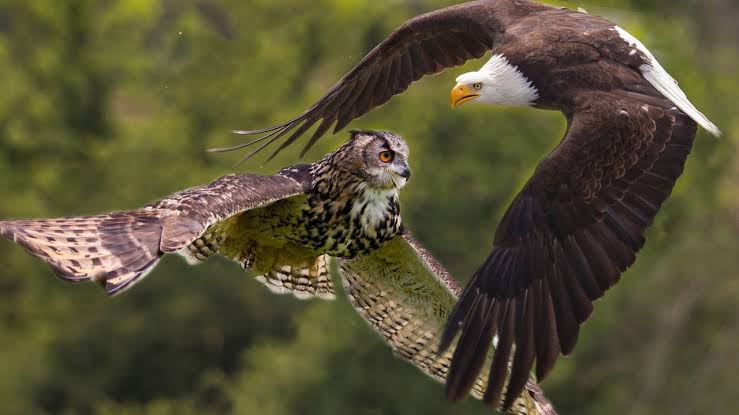
King owl vs American eagle
Great horned owl vs bald eagle
Hello everyone my name is UBEIDULLAH Khan
In a showdown between a bald eagle and a great horned owl, who would win?
A bald eagle has a wingspan that can be nearly seven feet. It can weigh up to 14 pounds. It has piercing yellow eyes and a large, hooked bill. It is a symbol of pride and power. In comparison, a great horned owl is puny. Its wingspan is not quite five feet, and it weighs about seven pounds at most.
Bald eagles and great horned owls have been struggling over the same piece of real estate at North Springfield Lake, in Springfield, Vermont, for some years now. If you think the bald eagles could easily evict their rivals, well, I’m sure they wish they could.
Vermont bird watchers, conservationists, and biologists were excited and hopeful in 2003 when bald eagles were spotted at the North Springfield Lake, a few miles west of the Connecticut River, carrying branches and other nesting materials. Until last year, Vermont was the only state in the continental United States not to have a breeding pair of bald eagles.
Sure enough, the eagle pair built a nest. Bald eagles build the largest nests in North America. The record is nine feet wide, and the nests are typically five feet deep. They can support the weight of a grown man. However, this eagle pair, after building their nest, did not take the next logical step and lay eggs.
“They might have been just playing at building a nest,” says Gary Pelton, a wildlife biologist for the U.S. Army Corps of Engineers at North Springfield Lake. Sometimes bald eagles appear to build a nest for practice, he says.
Forrest Hammond, a wildlife biologist with the Vermont Fish and Wildlife Department, says it can take bald eagles a whole season to build a nest. The pair then uses that nest the next year.
When the lake froze over that winter, the bald eagles moved on. Bald eagles are primarily fish-eating birds; they need open water to feed.
Great horned owls, meanwhile, don’t eat fish. It’s one of the few things they don’t eat. This adaptable bird is best known for being the only animal that regularly eats skunks. Great horned owls also eat geese, crows, other raptors, amphibians, and reptiles, but mostly they eat small mammals, such as rabbits.
Great horned owls nest early in the year. They may lay eggs in late January or early February. They don’t have to wait for a thaw. They don’t have to wait to build a nest. They don’t even build their own nests.
These owls typically use nests abandoned by crows and hawks, which may build new nests each year. The owls are such sloppy housekeepers that they do nothing to fix or refurbish the nests they use. They also don’t reuse the nest the next year. Usually, they’ve trashed it.
The winter after the bald eagles built a nest at North Springfield Lake, great horned owls laid their eggs and raised their young in it. By the time the bald eagles returned to the lake, the owls were already established, defending the nest from the eagles that built it.
It’s logical that the much larger eagle should have no problem getting a great horned owl to do its bidding. But no. While it may not be much of a nest-builder, the great horned owl is fierce, while a bald eagle is laid back, some even say lazy. No match for the owl.
So the great horned owls used the nest in 2004 while the eagle pair remained nest-less and nearby, Pelton reports. The following year, after the great horned owls did not return to the nest, the bald eagles resumed bringing nest materials to the site. Bald eagles have a strong nest-building instinct and will refurbish a nest year after year. One bald eagle nest in New Hampshire was observed being occupied for 45 years.
But again in 2005, although the eagles refurbished the nest, they did not lay eggs. And again the following year, the great horned owls got to the nest first and laid their eggs there.
Pelton, Hammond, and others say that the North Springfield Lake is probably not the best site for a bald eagle nest. The lake stays frozen too long, hemming in the eagles’ potential nesting season.
In 2006, bald eagles did nest in Rockingham, not far from North Springfield Lake. Vermont finally had its breeding bald eagle pair.
The great horned owls are not the bad guys. They’ve been stealing nests from bald eagles for millennia without harming bald eagle populations. The bald eagle’s bigger competition for real estate is with us. We like the same waterfront sites for our homes that bald eagles prefer for their nests. Our laws protect bald eagle nest sites, but only if the eagles get there first.
 Site Title